
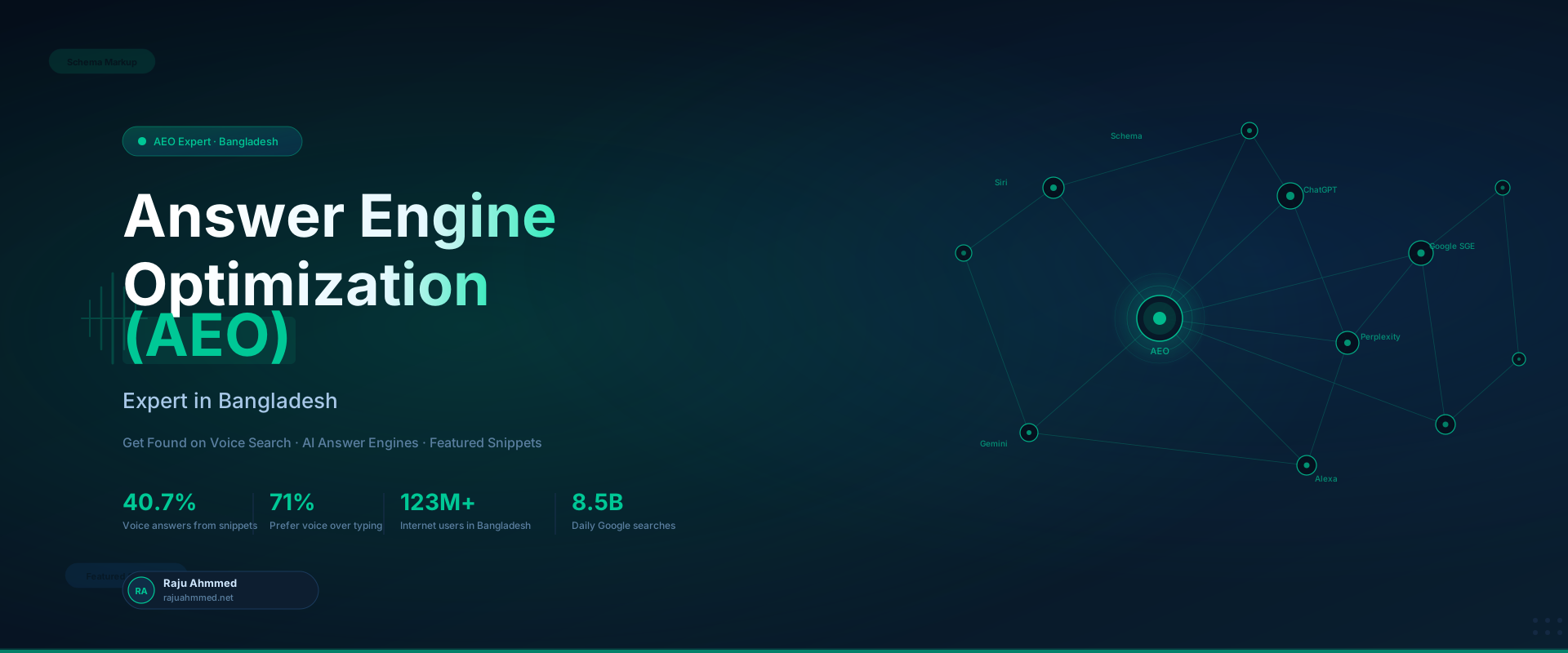
Answer Engine Optimization (AEO) Expert in Bangladesh
Get Found on Voice Search & AI Answer Engines
The way people search is changing — fast. More than half of all online searches now happen without a single click on a result. Instead, users get a direct answer from Google, Siri, Alexa, or ChatGPT. If your website isn’t feeding those answers, you’re invisible where it matters most. I help businesses in Bangladesh get found, featured, and trusted by AI answer engines — before the competition catches up.
About
I’m Raju Ahmmed, an Answer Engine Optimization (AEO) and Voice Search specialist based in Bangladesh. With hands-on experience in semantic SEO, structured data implementation, and AI-driven content strategy, I help local and global businesses adapt to the next era of search. My work sits at the intersection of traditional SEO and the fast-evolving world of AI-powered answers — because ranking on Google is no longer enough.

What is Answer Engine Optimization (AEO)?
Answer Engine Optimization (AEO) is the practice of structuring your content so that AI systems, voice assistants, and search engines can extract and present it as a direct answer.
Unlike traditional SEO, which focuses on ranking a page on a results list, AEO focuses on becoming the answer. Platforms like Google’s AI Overviews, ChatGPT, Perplexity, Microsoft Copilot, and voice assistants like Siri and Alexa pull answers directly from web content. AEO ensures your content is the one they pull from.
According to a 2024 study by Semrush, over 19% of Google search queries now trigger a Featured Snippet or AI-generated answer. That number climbs significantly for question-based and conversational queries. AEO targets these zero-click moments strategically — using schema markup, structured content, entity optimization, and conversational language that matches how AI processes information.
Think of it this way: SEO gets you on the shelf. AEO puts your product in the customer’s hand.
Why AEO & Voice Search Matter for Businesses in Bangladesh
Bangladesh is one of the fastest-growing digital economies in South Asia. With over 130 million internet users and smartphone penetration rising sharply, the shift to voice and AI-driven search is already underway — and most local businesses aren’t prepared.
Why Voice Search is Growing in Bangladesh
Voice search adoption in Bangladesh is being driven by a clear set of factors:
- Mobile-first behavior: Bangladesh ranks among the top countries for mobile internet usage, with over 97% of users accessing the web via smartphone (GSMA, 2024). Voice search is the natural fit for on-the-go mobile users.
- Vernacular and conversational queries: Bangladeshi users increasingly search in conversational Bangla and mixed Banglish phrasing — the exact query style that voice search is built for.
- AI assistant adoption: Google Assistant and Siri are pre-installed on nearly every Android and iOS device sold in the country, making voice search a default behavior rather than a deliberate choice.
- Rising digital literacy: Government initiatives under the “Smart Bangladesh 2041” vision are accelerating digital adoption across urban and rural populations alike.
According to Google, 27% of the global online population uses voice search on mobile. In fast-growing mobile markets like Bangladesh, that figure is climbing faster than the global average.
Why AEO & Voice Search Matter for Your Business
If your business doesn’t show up in voice or AI-generated answers, a competitor’s does. It’s that simple. Here’s what’s at stake:
- Zero-click searches are the new normal. SparkToro research found that over 65% of Google searches now end without a click. The only way to capture that audience is to be the answer.
- AI Overviews are reshaping traffic. Since Google’s AI Overviews rollout (2024), many traditional top-ranking pages have seen organic CTR drop. Pages cited in AI answers, however, gain authority and referral traffic.
- Local voice queries drive foot traffic. Searches like “best restaurant near me” or “pharmacy open now in Dhaka” are almost entirely voice-driven. Businesses optimized for these queries win the walk-in customer.
AEO isn’t a future-proofing strategy. It’s a present-day competitive advantage.
Role of an Answer Engine Optimization (AEO) & Voice Search Expert in Bangladesh
An AEO expert bridges the gap between what your business offers and how AI systems understand and present information. In the Bangladesh context, that role carries extra weight — because most competitors are still playing the old SEO game.
My role covers:
- Auditing your existing content for AEO readiness — identifying gaps in structure, schema, entity coverage, and conversational relevance
- Keyword and query research focused on how your audience actually speaks, not just how they type
- Implementing structured data (Schema.org markup) so Google and AI engines can extract clean, accurate answers from your pages
- Optimizing for Google’s Knowledge Graph by strengthening your topical authority and entity associations
- Monitoring AI citation patterns across tools like Perplexity, ChatGPT, and Gemini to track your brand’s AI visibility
- Advising on content architecture — because the structure of your information matters as much as the information itself
In a market where AEO expertise is still rare, having a specialist in your corner isn’t a luxury — it’s leverage.
Benefits of Hiring an AEO & Voice Search Expert in Bangladesh
1. Improve Your Online Visibility
AEO puts your content in front of users who never reach the search results page. When Google’s AI Overview, a voice assistant, or a chatbot cites your content, you gain visibility without relying on a click. Structured, authoritative content surfaces across multiple platforms — Google, Bing, ChatGPT, Perplexity — multiplying your reach from a single optimization effort.
2. Understand User Intent
AEO demands a deeper understanding of why someone is searching, not just what they typed. I map your content to all four layers of user intent — informational, navigational, commercial, and transactional — and align them with the specific questions your audience is asking AI systems. This results in content that genuinely satisfies the user, which is exactly what Google’s Helpful Content guidelines reward.
3. Boost Local SEO
Voice search is hyper-local by nature. Queries like “AEO expert in Dhaka” or “SEO agency near me in Bangladesh” are precisely the type of searches I optimize for. I align your Google Business Profile, local citations, and on-page content to capture these high-intent, geo-specific queries — the ones that convert visitors into customers the fastest.
4. Enhance User Experience
AI-friendly content is, by definition, user-friendly content. Clear structure, concise answers, logical flow, and fast-loading pages aren’t just good for algorithms — they’re good for people. Optimizing for AEO naturally improves readability, reduces bounce rate, and makes your website a more trustworthy destination overall.
5. Stay Ahead of Competitors
The majority of businesses in Bangladesh have not yet invested in AEO. This is a significant first-mover opportunity. Early adoption means faster indexing in AI knowledge bases, stronger entity recognition in Google’s Knowledge Graph, and a larger share of AI-generated citations before the space becomes crowded. The businesses that act now will be significantly harder to displace later.
6. Save Time and Resources
Hiring an AEO specialist means you’re not paying for trial-and-error learning. I bring proven frameworks, tested schema templates, and up-to-date knowledge of how Google’s AI systems evaluate content — so your investment goes into results, not experimentation. You focus on your business. I focus on your visibility.
7. Increase Conversions
AEO traffic is high-intent traffic. Users who find your business through a voice query or an AI-generated answer are typically deep in the decision process — they’re looking for a specific answer, a local provider, or an immediate solution. That intent converts. Businesses that appear as trusted AI-cited sources consistently see higher engagement rates, lower bounce rates, and stronger lead quality.
How I Use AI to Optimize Content for Answer Engine Optimization (AEO) & Voice Search
AI and voice search rely on structured, intent-driven content. This type of content allows search engines and AI assistants to pull answers directly from your website. My approach ensures your content is AI-friendly, voice-search optimized, and structured for direct responses.
I use a combination of AI-powered content tools — including Surfer SEO, Clearscope, and custom GPT-based workflows — alongside traditional SEO platforms like Ahrefs and Semrush to identify content gaps, optimize semantic coverage, and validate entity relationships. The result is content that doesn’t just rank — it answers.
Every piece I optimize goes through a structured checklist: Is the primary question answered in the first two sentences? Is schema markup present and valid? Does the content cover related entities and subtopics that AI systems associate with this query? Is the reading level appropriate for voice output? These aren’t optional extras. They are the baseline for AEO-ready content in 2025.
How I Optimize for AEO & Voice Search
1. Conversational Query Optimization
I research natural language queries, long-tail keywords, and question-based searches. This helps your content answer the exact questions users ask AI assistants.
Using tools like AnswerThePublic, AlsoAsked, and Semrush’s Keyword Magic Tool, I map out the full question universe around your topic — then structure your content to address those questions in the natural, direct way that voice assistants prefer. Short sentences, clear answers, no jargon.
2. Structured Data & Schema Markup
I implement FAQ, How-To, and Speakable schema. This ensures AI can extract the right answer quickly and accurately.
Google explicitly supports Speakable schema to help voice assistants identify which content is appropriate for audio responses. I implement this alongside FAQ and How-To schema to give your content maximum extractability across AI and voice platforms. All markup is validated through Google’s Rich Results Test before deployment.
3. Featured Snippet Targeting
I format content with bullet points, step-by-step instructions, and concise summaries. This boosts your chances of appearing in Google’s answer boxes.
Featured Snippets appear in approximately 12.3% of all search queries, according to Ahrefs data. For question-based queries — the dominant format in AEO — that percentage is significantly higher. I use paragraph snippets for definition-type queries, list snippets for how-to content, and table snippets for comparison content, matching format to the query type that Google already favors.
4. Entity Optimization & Semantic SEO
I strengthen connections with Google’s Knowledge Graph. This improves visibility in AI-driven searches and enhances context for your content.
Entity optimization means making it unambiguous to Google who you are, what you do, and how you relate to other established entities in your industry. I build internal linking structures that reinforce topical authority, use structured data to associate your business with the correct Knowledge Graph entities, and optimize your About and Contact pages to improve brand entity recognition.
5. Mobile & Local Voice Search Optimization
I optimize content for location-based searches, “near me” queries, and instant answers. This ensures users get the right information on the go.
For Bangladeshi businesses, this means optimizing Google Business Profiles with complete NAP data, updating service area information, adding Q&A content to business listings, and ensuring website speed meets Core Web Vitals thresholds — because slow pages don’t get featured in voice results.
6. Contextual Linking & Entity Mapping
I build internal link structures that map semantic relationships between your content clusters, reinforcing topical authority signals to both Google and AI crawlers. Entity mapping ensures that every key concept on your site connects logically to related topics — the way a knowledge base, not just a website, is structured. This is the architecture that AI systems trust.
Is AEO Different from Traditional SEO?
Yes — significantly. Traditional SEO optimizes for ranking. AEO optimizes for answering.
Traditional SEO is built around keywords, backlinks, and page authority — the goal is to appear as high as possible in a list of results. AEO works at a different layer: it structures information so that AI systems, voice assistants, and search engines can skip the list entirely and pull your content as the answer itself.
That said, AEO doesn’t replace SEO — it extends it. Strong technical SEO (fast load times, clean site architecture, mobile optimization) remains the foundation. AEO adds the structural and semantic layer on top: schema markup, conversational query alignment, entity optimization, and featured snippet targeting.
The key difference is the end goal. SEO asks: Can Google find and rank my page? AEO asks: Can Google understand and cite my page as a trusted answer? In the age of AI search, the second question is the one that drives business results.