
Increase Your Traffic By 50% With On-Page SEO

Get Expert On Page SEO Services in Bangladesh With Proven Results Today
Claim Your FREE On-Page SEO Audit, There Is Nothing To Lose.
On-Page SEO Expert | Certified SEO Specialist Services
Struggling to rank despite publishing content regularly? The problem often lives on your page — not off it.
I’m Raju Ahmmed, a certified On-Page SEO specialist based in Bangladesh with hands-on experience optimizing title tags, meta descriptions, heading hierarchies, content structure, internal linking, and Core Web Vitals — everything Google evaluates before ranking your page.
My on-page audits go beyond surface-level fixes. I analyze semantic relevance, keyword intent alignment, E-E-A-T signals, and entity optimization to build pages that satisfy both crawlers and users.
Whether you need a single-page audit or a full-site on-page overhaul, I deliver clear, prioritized action plans — not generic checklists.
Learn what on-page SEO is, why it matters, and how to optimize your content with proven techniques like title tags, meta descriptions, and internal linking.
You can have the most technically sound website on the internet — but if your on-page SEO is weak, Google will struggle to rank it. This guide breaks down every critical element of on-page optimization, common mistakes that silently kill rankings, and the exact metrics that tell you whether your strategy is actually working.
Introduction: What is on-page SEO and why does it matter?
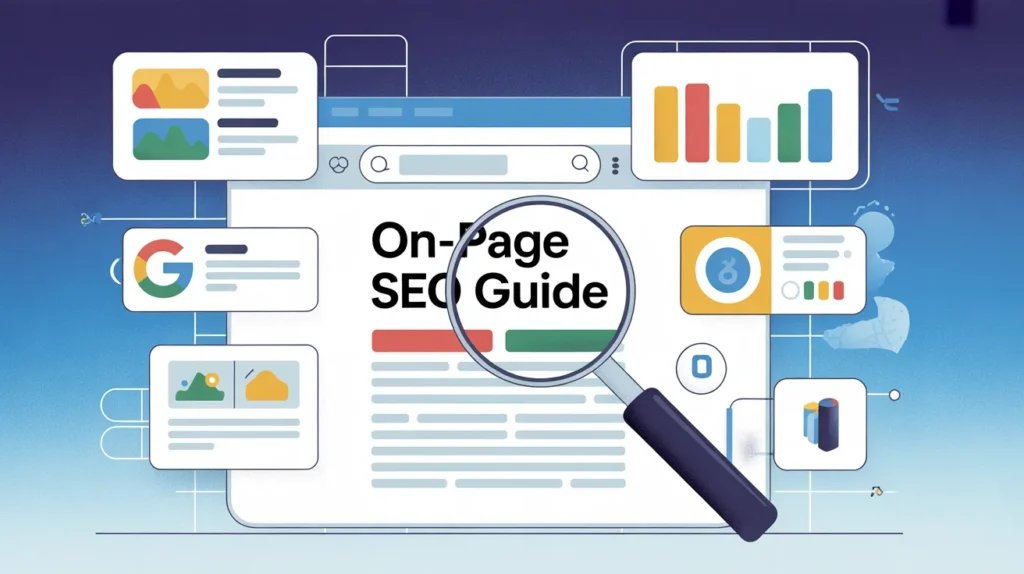
On-page SEO is the process of optimizing individual web pages so search engines understand what your content is about — and rank it for the right queries. It includes everything from your title tag and headings to content structure, keyword placement, and internal links.
Google processes over 8.5 billion searches every day (Internet Live Stats, 2024). Every one of those searches pulls from pages that are indexed, crawled, and evaluated for relevance. Without solid on-page SEO, your pages simply won’t appear when your potential customers are looking.
Think of it this way: you can open the best shop in Dhaka, but if there’s no signboard, no address, and no way to find it — it doesn’t matter. On-page SEO is your signboard, your address, and your reputation on Google.
The goal of On-Page SEO
The core goal is to make your page maximally relevant, readable, and trustworthy for both search engines and real users.
But it goes beyond just ranking. Strong on-page optimization reduces bounce rate, increases dwell time, improves crawl efficiency, and boosts your CTR in SERPs — all of which feed back into Google’s quality signals. According to BrightEdge (2024), organic search drives 53% of all trackable website traffic, making it the single highest-ROI channel for most businesses.
Get on-page SEO right, and you’re building a traffic asset that compounds over time — not a paid channel that stops the moment you cut the budget.
Expertise I Have
Key elements of on-page SEO
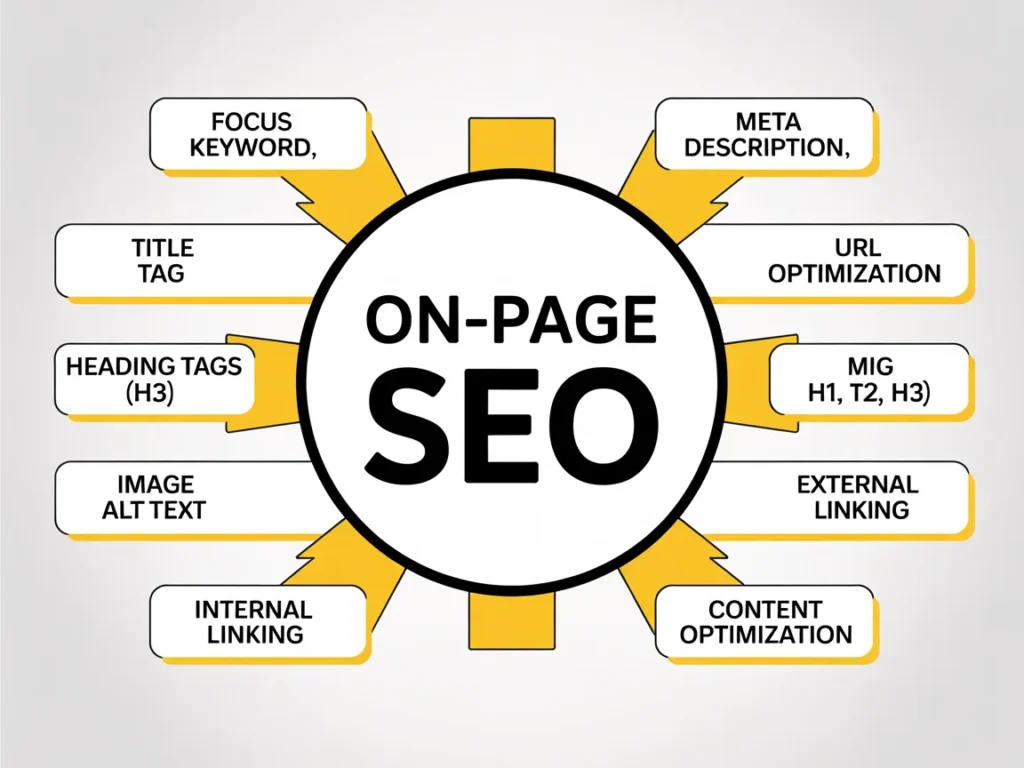
On-page SEO is not one thing — it’s a system. Each element works in concert to send relevance signals to Google and improve your page’s competitive position.
Title tags
Your title tag is the single most important on-page element. It’s what Google displays in SERPs, and it’s the first relevance signal crawlers read.
Keep title tags between 50–60 characters. Place your primary keyword as close to the front as possible. According to Moz’s On-Page Ranking Factors Study, the title tag remains one of the strongest individual ranking signals in Google’s algorithm. A title like “On-Page SEO Expert in Bangladesh | Certified SEO Services” outperforms a vague “Welcome to My Website” in every meaningful metric.
Meta descriptions
Meta descriptions don’t directly affect rankings — Google confirmed this years ago. But they dramatically affect click-through rate, which does influence rankings through user engagement signals.
Write meta descriptions between 150–155 characters. Include your primary keyword and a clear value proposition. Google will sometimes rewrite them (especially if your description doesn’t match the page’s content well), but a strong, intent-matched description gives you the best control over your SERP snippet.
Headings (H1–H6)
Headings create a content hierarchy that both users and crawlers rely on. Every page needs exactly one H1 — your main topic. H2s structure the major sections. H3s drill into sub-topics within those sections.
According to Semrush’s Ranking Factors research, pages with clear, hierarchical heading structures rank significantly better for long-tail queries and featured snippets. Don’t use headings purely for visual formatting. Each one should tell a coherent story about the page’s topic architecture.
URL structure
A clean URL is short, descriptive, and contains your primary keyword. Google’s John Mueller has confirmed that URLs are a lightweight ranking signal — but their real power lies in click-through rates and link equity distribution.
- ❌ yoursite.com/p?id=1293
- ✅ yoursite.com/on-page-seo-expert-bangladesh
Use hyphens (not underscores), avoid stop words where possible, and keep URLs under 75 characters. Every URL should be readable by a human without any explanation.
Internal linking
Internal links distribute PageRank across your site and help Google map your topical authority. They also keep users engaged longer — which improves session depth and behavioral signals.
Link from high-authority pages to pages you’re trying to rank. Use descriptive, keyword-rich anchor text — never “click here.” Ahrefs data shows that pages with strong internal link profiles consistently rank higher, even against pages with more external backlinks. This is especially powerful for newer sites building domain authority from scratch.
Keyword optimization
Keyword placement still matters in 2025 — but context and semantic relevance matter more. Google’s NLP systems (BERT, MUM) understand meaning, not just exact-match strings.
Place your primary keyword in: the H1, the first 100 words, at least one H2, the meta title, and the meta description. Use semantically related terms throughout the body. Target a keyword density of 0.5%–1.5% — enough to signal relevance without triggering over-optimization filters. Tools like SurferSEO or Clearscope help you map the right semantic coverage for any topic.
Content quality and relevance
Google’s Helpful Content System — launched in 2022 and updated multiple times since — specifically targets pages that exist to rank rather than genuinely help users. Low-quality, thin, or SEO-first content gets demoted at a site-wide level.
Your content must satisfy search intent completely. It should demonstrate E-E-A-T (Experience, Expertise, Authoritativeness, Trustworthiness) — the framework Google’s quality raters use to evaluate pages. A 2023 Semrush study found that long-form content (1,500+ words) earns 3.5x more backlinks and ranks for significantly more keyword variations than short-form content. Depth wins.
Image optimization
Every image on your page is either an asset or a liability. Unoptimized images slow your site and confuse crawlers.
Use descriptive file names (on-page-seo-checklist.webp not IMG_0032.jpg). Add keyword-relevant alt text to every image — this also improves accessibility. Use WebP format instead of JPEG or PNG wherever possible. According to Google PageSpeed Insights data, image optimization alone can reduce page load time by 30–50% on image-heavy pages. That directly impacts Core Web Vitals.
Mobile-friendliness and page experience
Google completed its mobile-first indexing rollout in 2021. It now uses the mobile version of your page as the primary basis for ranking — regardless of where your actual traffic comes from.
Your page must pass Core Web Vitals thresholds: LCP under 2.5 seconds, INP under 200 milliseconds, and CLS under 0.1. These are Google’s official benchmarks for “good” page experience. Pages that fail Core Web Vitals are competing with a structural disadvantage, no matter how good their content is.
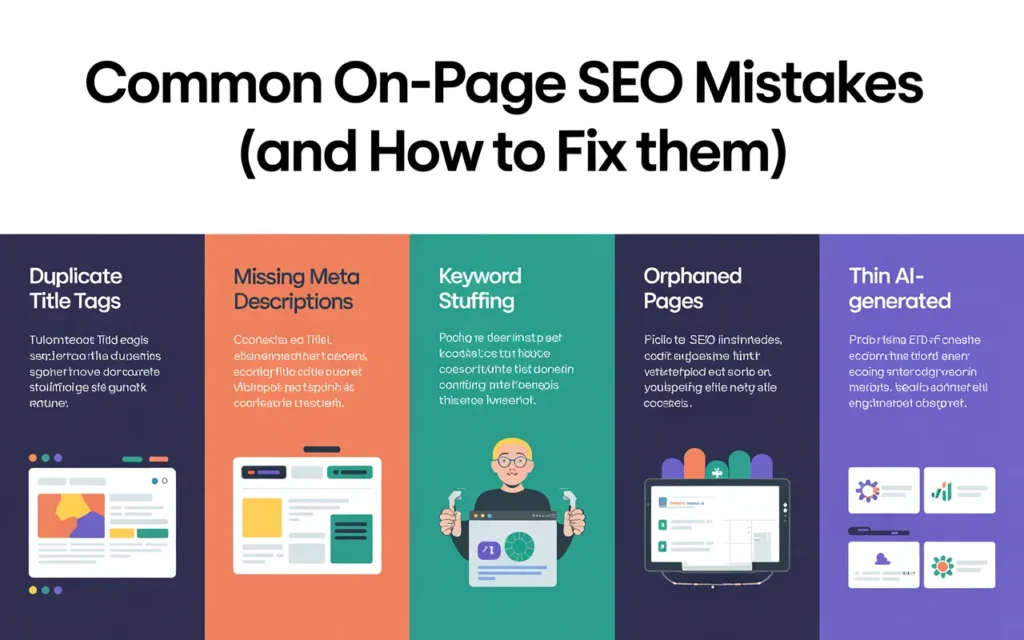
Even experienced SEO specialists make on-page errors. Here are the most damaging ones — and the exact fixes.
Duplicate title tags
Running the same title tag across multiple pages confuses Google about which page to rank. It splits ranking signals and suppresses both.
Fix: Crawl your entire site with Screaming Frog. Filter for duplicate title tags. Assign a unique, keyword-targeted title to every indexed page.
Missing meta descriptions
When meta descriptions are missing, Google auto-generates them — often pulling random text that’s irrelevant or unappealing. You lose control of your SERP snippet and CTR drops.
Fix: Run a Semrush Site Audit or Screaming Frog crawl. Export all pages with missing meta descriptions. Write intent-matched, 150–155 character descriptions for every indexed page.
Keyword stuffing
Overusing your target keyword is a fast track to Google’s spam filters. Google’s Search Quality Evaluator Guidelines explicitly flag pages with unnaturally inserted keywords as low-quality.
Fix: Write for humans first. Use synonyms, LSI terms, and related phrases. Tools like Clearscope and SurferSEO show you the optimal semantic keyword spread so you never have to guess.
Orphaned pages
An orphaned page has zero internal links pointing to it. Google’s crawler may never discover it — or crawl it so rarely that it never builds enough ranking momentum.
Fix: Run a site crawl in Screaming Frog. Filter for pages with no incoming internal links. Connect each one to a contextually relevant page using descriptive anchor text.
Thin or AI-generated content
Post-HCU, Google demotes thin content aggressively — including AI-generated pages that lack real depth, firsthand experience, or genuine insight. This is not speculation; Google’s Search Quality Evaluator Guidelines directly address this.
Fix: Add firsthand perspectives, original case studies, real data, or expert commentary. AI tools are useful for drafts — but human editing, experience signals, and factual depth are non-negotiable if you want to rank in 2025.
Cannibalization issues
When two or more pages target the same keyword with similar intent, they compete against each other. Google splits PageRank between them and neither ranks well.
Fix: Use Google Search Console’s Performance report to identify pages ranking for overlapping queries. Consolidate, canonicalize, or differentiate them based on intent — informational vs. commercial, for example.
How to measure on-page SEO success
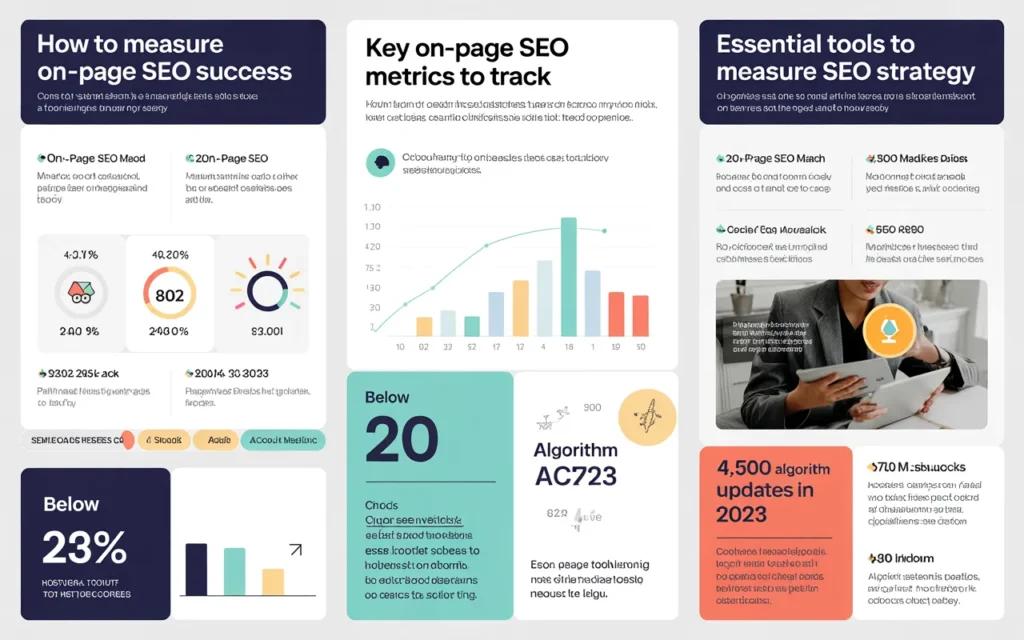
You can’t improve what you don’t track. These are the metrics and tools that tell you exactly where your on-page strategy stands.
Key on-page SEO metrics to track
- Organic impressions & clicks — Trending up in Google Search Console means your pages are gaining SERP visibility.
- Average position — Are target keywords moving toward page one?
- Click-through rate (CTR) — Below 2%? Your title tags and meta descriptions need work.
- Bounce rate & dwell time — High bounce + low time-on-page signals a content-intent mismatch.
- Core Web Vitals scores — LCP, INP, CLS via Google Search Console’s Page Experience report.
- Indexed pages vs. crawled pages — A wide gap often signals crawl budget or indexing issues.
Essential tools to measure SEO strategy
- Google Search Console — The ground truth for impressions, CTR, average position, and indexing status. Free and non-negotiable.
- Ahrefs / Semrush — Keyword rank tracking, content gap analysis, backlink profiles, and site audits.
- Screaming Frog SEO Spider — Deep technical crawl data including on-page issues, internal link analysis, and duplicate content flags.
- Google Analytics 4 — User behavior, session depth, conversion tracking, and traffic source breakdowns.
- PageSpeed Insights — Real-world Core Web Vitals data pulled directly from Google’s CrUX dataset.
Set benchmarks and keep improving
On-page SEO is a continuous process — not a one-time checklist. Google made over 4,500 algorithm updates in 2023 alone (confirmed in Google’s internal testing documentation). The SERPs you’re targeting today will look different in 90 days.
Run a full on-page audit every quarter. Compare organic traffic and keyword rankings month-over-month. Identify underperforming pages and refresh them with updated statistics, improved keyword coverage, stronger E-E-A-T signals, and better UX. Pages that receive regular content updates consistently outperform stale content in competitive SERPs — especially in YMYL-adjacent niches.
The brands that treat on-page SEO as an ongoing investment — not a launch task — are the ones that hold top positions through every algorithm update.
Looking for a certified on-page SEO expert who combines technical precision with content quality? Raju Ahmmed delivers data-driven SEO services across Bangladesh — from Dhaka to Chittagong — built on proven optimization strategies and measurable results.